A wellbeing benefit you can actually govern
Give hourly staff earlier access to pay they have already earned, while Finance keeps policy, float and reconciliation.
You set the rules once: the access cap, withdrawal limits and the payroll-block window. Every request is checked against them automatically.

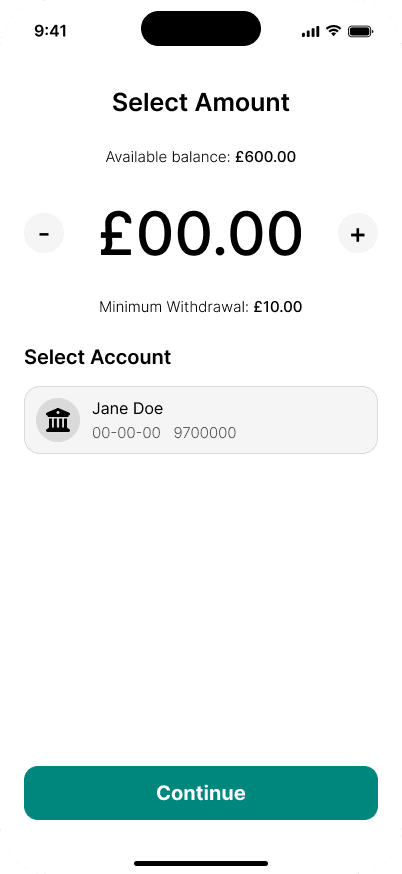
What earned wage access actually is
The mechanism comes before the business case, so you can judge it rather than take it on trust.
It is their own pay, reached earlier
An employee can reach part of the wages they have already worked for, before your normal payday. Early access to wages already earned, not a loan and not credit. No credit check, and no effect on an employee's credit score.
It is built from the hours you send us
You send approved hours as a CSV or spreadsheet upload through the portal, or over an API connection. Nothing you have not submitted can be drawn against. It is built from the approved hours you import, not from an estimate of hours worked.
It stays inside the rules you set
You set the rules once: the access cap, withdrawal limits and the payroll-block window. Every request is checked against them automatically. Nothing waits on your team. A request either passes the rules you set or it is declined.
It is your money, returned through payroll
Withdrawals are paid from your float, an account you fund ahead of time. StatimPay is not a lender, and none of the money paid out is its own. At the end of each pay period StatimPay issues a consolidated deduction report, in the portal and as an export. You deduct the withdrawal and its fee in your own payroll, then remit the fees to StatimPay.
The employee pays a flat fee, not interest
£1.80 per withdrawal. No interest. No variable rates. A flat fee only. The employee pays the fee. You collect it at payroll and remit it to StatimPay.
Four levers, all yours
Set them at onboarding, change them whenever your operating model changes.

- What can be drawn
- A request cannot exceed the hours you imported, cannot breach the limits you set, and cannot go out if your float will not cover it.
- The cap
- Employees can take up to 50% of their estimated net earned pay. You can set a lower cap, never a higher one.
- Timing
- A payroll-block window before payday stops late withdrawals from disrupting your pay run.
- Float and exposure
- Low-balance alerts warn you when the account falls below a level you set, before it runs short.
What earned wage access does for you
A benefit you fund from your own float and bound with your own rules, offered for reasons your Finance lead can check.
Recruit
of UK employees said in 2022 that it is important that a future employer has a financial wellbeing policy. 59% of staff say the same about the employer they already work for. In a market where hourly staff are hard to hire, that is a reason to be the employer who offers one.
Source: CIPD Reward Management Survey 2022, survey of 2,500 UK employees (opens in a new tab).
Stand apart
of UK organisations have a formal financial wellbeing policy or strategy. Only 31% of employers with benefits objectives link them to boosting productivity or business performance. Most of the employers you compete with for staff have no answer here.
Protect the shift
of UK employees said money worries had negatively affected their work performance. For wider context, sickness absence from all causes now runs at 9.4 days of sickness absence per employee per year (close to two working weeks), up from 7.8 days in 2023.
Sources: CIPD Good Work Index 2025, survey of 5,019 working adults (opens in a new tab); CIPD Health and Wellbeing at Work 2025, survey of 1,101 HR decision-makers (opens in a new tab).
Published research on the UK workforce, not StatimPay results. If your team is salaried and paid monthly with little variability, this is probably not for you.

The honest version
Two commitments and one open question, stated up front rather than discovered on a call.
Join the pilotYou fund the float
Between a withdrawal and your pay run, that amount is out of your float and not yet settled. That is a real cash-flow commitment, and it scales with how much your team uses this.
You take on a payroll step
We issue the consolidated deduction report; entering it and remitting the fees is work your payroll team does not do today. It is a small step, but it is a new one, every period.
What StatimPay charges you
Commercial terms, including any platform fee and any minimum float balance, are agreed with you before a pilot starts, not buried in a footnote here.
Tell us how you run
StatimPay EWA is pre-launch. We are recruiting a small group of pilot employers. We will be straight with you about whether a pilot makes sense yet.